Walk into a group fitness class at almost any gym and you’ll find the same mix: a few people who’ve been coming for two years, a few who signed up last week, and a lot of people somewhere in between. Different movement vocabulary. Different strength baselines. Different comfort with intensity.
Most coaches handle this by coaching to the middle - picking cues and intensity that work for the average member and hoping the outliers figure it out. Veterans under-challenged, beginners lost, and the coach trying to manage a room that’s never quite landing together.
This isn’t a coaching failure. It’s a design problem. And it’s solvable.
Why This Is an Operator Problem, Not Just a Coaching Problem
The immediate cost is easy to see: beginners feel out of their depth and stop coming back. Veterans plateau and get bored. Class ratings drop.
The downstream cost is less obvious but bigger. Coaches who don’t know how to manage ability ranges spend their focus managing chaos instead of coaching. Their attention goes to damage control. Their instruction gets thinner. Regular members notice, even if they can’t name it.
A mixed-ability class that runs badly is also the exact environment that drives your best coaches out. If every class feels like controlled chaos, the ones with options will eventually find somewhere they can actually coach.
Getting this right is worth the investment - not just for new members, but for class quality across the board.
The Two Failure Modes
Coaching to the average. The coach picks a standard version of each movement, coaches that version, and assumes everyone can adapt. Veterans do fine. Beginners get a vague sense that they’re doing something wrong but don’t know how to fix it. Mods get mentioned once, quickly, at the start of the movement, and then never again.
Over-individualization. The coach tries to give everyone personal attention in real time. They spend the class circling members, correcting individual form, offering personalized scaling. The class loses rhythm. Members who aren’t being helped feel ignored. The coach exhausts themselves and still leaves work undone.
The fix isn’t in the middle of those two. It’s in the design.
Build a Floor and a Ceiling Into Every Movement
Before class starts, every movement on the programming should have three versions: the standard version, a scale-down for members who need it, and a progression for members who have the capacity.
This is the foundation of everything else. If you don’t have it, you’re improvising during class - and improvised scaling usually means calling out one member in front of everyone, which is exactly the wrong thing.
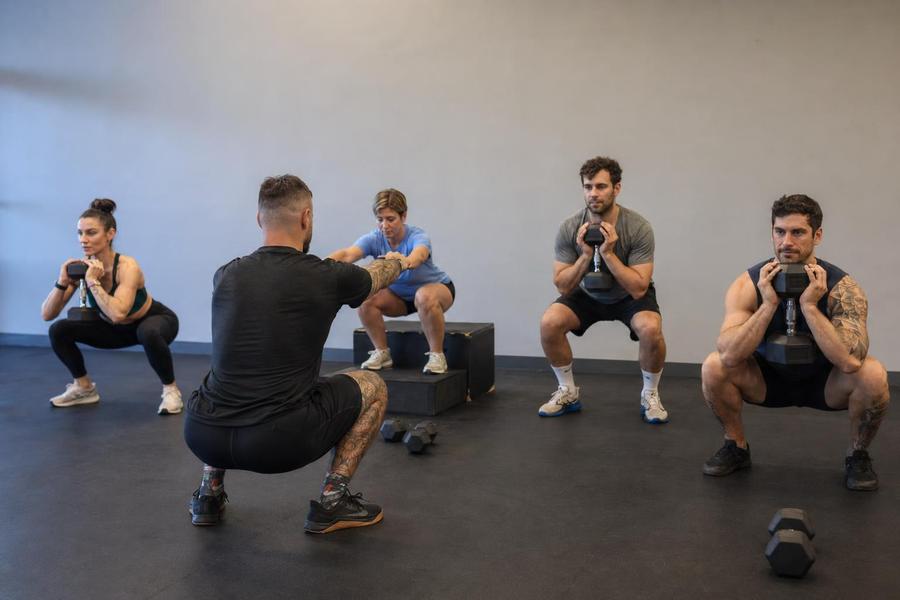
For a goblet squat, that might look like:
- Floor: Bodyweight squat to a box or chair (no load, guided depth)
- Standard: Goblet squat at moderate weight with tempo coaching
- Ceiling: Goblet squat at heavy load, or a front squat for athletes ready for it
You’re not running three classes. You’re running one class with built-in range. Members self-select based on how they feel that day - and the coach can redirect individuals quickly because the framework already exists.
When you centralize programming, this is part of the coach’s prep document. They receive the workout and the scaling options. They don’t invent modifications on the fly.
Present All Options at the Start, Not Just for Beginners
This is the part that gets skipped most often.
Most coaches mention modifications once, quickly, before the main set - and frame it as “if you can’t do the full version.” That framing tells beginners that the modification is a lesser choice. It singles out the people who need it. And it trains everyone else to ignore scaling options entirely.
A better approach: introduce all three options as legitimate choices for different goals that day.
“We’ve got three versions today. Box squat if you’re working on depth or coming back from something - this is the one where you’ll get the most out of the position. Goblet squat is the main format. Front squat if you’ve got that pattern solid and want to load it heavier.”
Same information. No hierarchy implied. Members pick what’s right for them without needing a coach to identify them as struggling.
This matters more than it sounds. Members who feel embarrassed by needing a modification either push through something they shouldn’t, or quietly decide the class isn’t for them. Presenting options as legitimate removes the stigma. It also makes it easier for your veterans to self-select into harder variations without the coach having to track who’s ready for what.
Layer Your Cues Instead of Splitting Your Attention
The other piece that breaks down in mixed-ability classes is cueing. Beginners need fundamentals explained. Veterans need technical depth and challenge cues. Coaching both simultaneously in real time is genuinely hard.
The answer is layered cues: a primary cue that applies to everyone, followed by a second-layer cue for members who have the first thing handled.
“Brace your core before you hinge - that’s the most important thing. If you’ve got that, focus on driving your hips back first, not down.”
You’ve given the beginner something actionable. You’ve given the veteran something to refine. You said it in four seconds and it applies to the whole room.
Build two or three of these per movement into your coaching notes. Primary cue, add-on. New members work on the first. Experienced members hear the second as confirmation they’ve got the first and can push further. Nobody gets left behind, and you’re not running separate coaching tracks.
Reading the Room Before You Start
The warmup is your data collection window. Watch how members move through warmup patterns and you’ll know before the main set starts who needs your attention and where.
Someone struggling with a hip hinge pattern in the warmup is going to need help on Romanian deadlifts in the main block. Spot them now, approach quietly before the set starts, and give them a private heads-up. “The key for you today is this one thing - everything else is secondary.”
That kind of proactive attention is much less disruptive than waiting for visible struggle during the main set and having to correct in front of the group. It also signals to the member that the coach noticed them and thought about their session, which is the kind of attention that drives retention.
You won’t catch everything in warmup. But you’ll catch enough to make the main block run cleaner.
Standardizing Across Your Coaching Team
If one coach handles mixed-ability classes well and three others don’t, the skill isn’t systematized - it’s personal. Members at different class times have inconsistent experiences. That’s an operations problem.
Standardize the framework, not the style.
Every coach should know the floor/standard/ceiling for each movement in the week’s programming before they walk into class. That’s a template you build into the coaching prep document - not just sets and reps, but scaling options and one or two layered cues per movement.
When you evaluate coaches (live or on video), include mixed-ability management in the rubric: Were all three options presented? Were cues layered? Did the coach use warmup to identify members who needed proactive attention?
These are coachable behaviors. Once they’re on your evaluation criteria, they get practiced.
What Members Feel When It Works
Most members won’t consciously notice that a class was designed for mixed ability. They’ll notice something simpler: the class felt right for them. Not too easy, not overwhelming. Like someone designed it for where they are, not where they’re supposed to be.
That’s the experience that builds class loyalty. Members who feel consistently met at their level - challenged but not lost - come back. They refer people. They become the veterans in the back row who are good for every class they show up to.
Building that experience doesn’t require running separate beginner and advanced tracks. It requires coaches who design with range in mind, present options without judgment, and cue for everyone in the room.
That’s what you’re building for.
Related: Your Class Is Only as Good as Your Warmup | The Hidden Cost of Verbal-Only Instruction | Stop Skipping the On-Ramp | How to Evaluate Your Coaches | The Workout Isn’t the Product. The Instruction Is.