Adults 65 and older now visit gyms and health clubs more often than any other age group. That’s not a projection. That’s current IHRSA data, and it’s been trending in that direction for a few years.
Meanwhile, most gym programming is designed for a 32-year-old who wants to lose weight or get stronger for sport. The schedule reflects it. The coaching language reflects it. The way coaches give modifications reflects it.
The older members are there, paying dues, showing up, and figuring it out on their own.
A few operators have built something intentional for this demographic. Most haven’t. The ones who do it well aren’t running geriatric classes in a back corner. They’ve integrated aging-specific programming into a real, considered offering that older members actually want to be part of.
Here’s what separates those operators from the ones who are leaving this on the table.
The Problem With “Senior Fitness”
Most operators who try to serve older members make the same mistake: they build programming that signals limitation rather than capability.
“Chair yoga.” “Silver Sneakers.” A dedicated “older adults” track that runs Tuesday and Thursday mornings when nobody else is in the building. These can work in some contexts, but they often create a two-tier experience where older members know they’re being accommodated rather than included.
The issue isn’t what’s in the class. Chair yoga is genuinely useful. The issue is the framing and the isolation. When the entire offering for older members is quarantined into its own corner of the schedule, it communicates something about how the facility views those members.
The better model is integration. A gym that has genuinely good programming for people in their 50s, 60s, and 70s doesn’t necessarily have a separate track. It has coaches who know how to coach people across a real age and ability range, programming that addresses what this demographic actually needs, and a culture where showing up at 62 or 68 or 74 isn’t a footnote.
What Older Members Actually Need (That Most Programming Skips)
The physiology is real, and ignoring it doesn’t help anyone. People in their 60s and 70s are dealing with specific training considerations that younger adults mostly aren’t.
Power, not just strength. Strength (the ability to produce force) holds up reasonably well with age. Power (how fast you can produce that force) declines faster. The ability to catch yourself when you trip, to get off the floor, to react quickly. These are power functions. Programming that only builds slow, grind-through strength is missing the point. Include explosive work, even if it’s modified: step-ups, medicine ball work, quick-response balance drills.
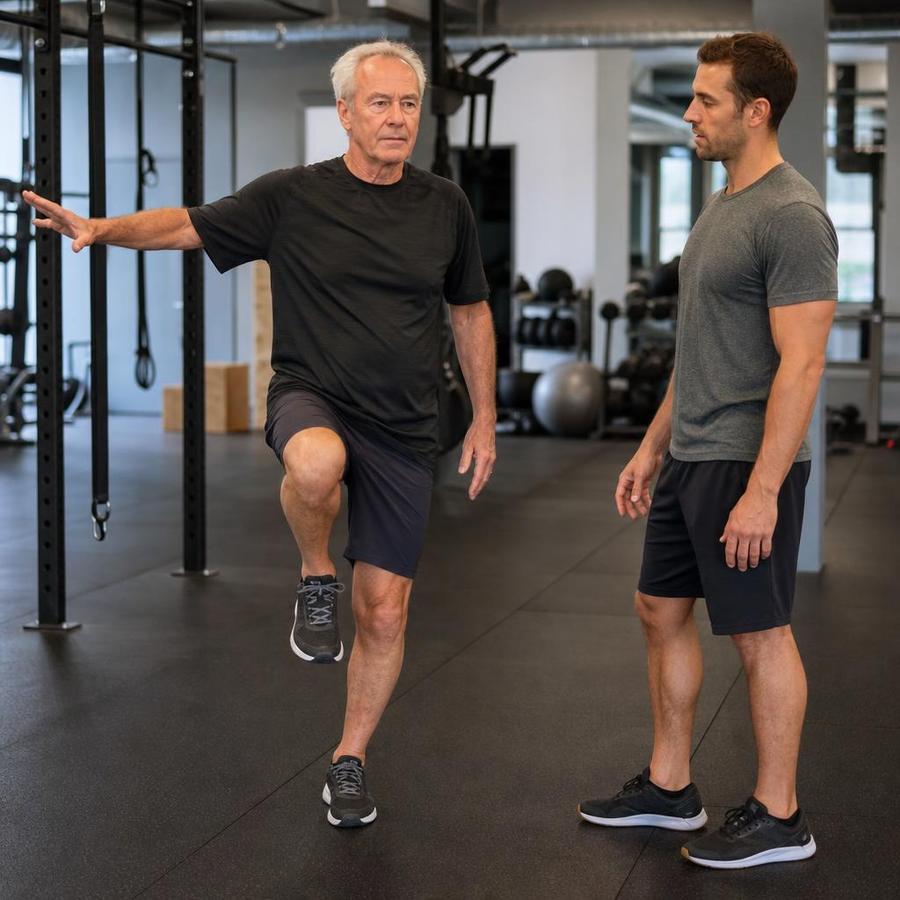
Balance as a training goal, not an afterthought. Most general fitness classes treat balance as a transition or a cooldown gimmick. For older adults, balance training has direct functional consequence. One fall is a major life event at 70 in a way it isn’t at 35. Programming that takes balance seriously (single-leg work, perturbation training, reaching patterns) isn’t rehab. It’s good programming.
Mobility and joint health. Range of motion matters more as tissue gets stiffer. The warmup that works for a 30-year-old who moves around all day might not be enough preparation for a 65-year-old who sits at a desk or has been more sedentary. Coaches need to know when to slow down and when to give members more time.
Appropriate loading, not no loading. The reflex in many gyms is to give older members the lightest options by default. That’s not coaching. Some members in their 60s are stronger than coaches in their 30s. Ask. Observe. Challenge people at their actual level, not an assumed one.
The Coaching Language Problem
The biggest issue in most group fitness settings isn’t program design. It’s how coaches talk.
“Beginners, elderly, and anyone with injuries, here’s your modification.”
If that’s your formula, you’re telling your older members they belong in the same category as the person who didn’t sleep well last night. You’re also cuing them to underwork.
Better approach: coach the movement standard, then offer clear progressions and regressions without labeling who they’re for. “For more challenge, add a hop. To build into this movement, step instead of jump.” That language lets people self-select without being sorted into categories.
Also: tone matters. Coaches who unconsciously adopt a softer, slower, more deferential voice when they’re working with older members are signaling something those members can feel. Talk to them like capable adults. They are.
Specific things to coach your instructors on:
- Don’t pre-modify. Don’t walk over and modify an older member’s setup before they’ve even tried it. Watch first.
- Name what the modification builds toward, not away from. “This variation builds the hip stability you need to get to the full movement” is different from “this is easier on your knees.”
- Coach the goal, not the limitation. The goal is function, power, balance, strength. Coach toward that.
Building a 55+ Programming Track Without Creating a Ghetto
If you do want a dedicated offering for older adults, and there’s a good argument for it, structure matters.
Name it for what it does, not who it’s for. “Strength and Function” or “Strong for Life” tells someone what they’ll get. “Senior Fitness” or “55+ Class” leads with demographic identity. The first invites. The second sorts.
Run it at times that make sense, not times that are convenient for the schedule. Mid-morning on weekdays is where most gyms dump older-adult classes because the floor is empty. But that’s also when many older adults prefer to train, so it can work. Just make sure the reasoning is about them, not about your floor utilization.
Staff it with your best coaches. This is a non-negotiable. Older adults are more discerning than most, they have more experience evaluating people, and they don’t tolerate a coach who’s clearly phoning it in. Don’t give this population the newest, least experienced coach because you think it’ll be easy. It won’t be.
Keep the class genuinely challenging. A dedicated older-adult class that doesn’t push anyone isn’t doing its job. This demographic has usually done some version of exercise their whole lives. A lot of them have trained hard. They didn’t stop caring about results just because they turned 60. The class should feel like a real workout.
Bridge it to the main schedule. The goal is eventually to have members who started in a 55+ class feel confident enough to take a general-population class. Design the track to build toward that where possible. Not everyone will want to, but the ones who do should have a clear path.
The Scheduling and Retention Angle
Older adults, as a group, are more loyal than almost any other member demographic. They have more schedule flexibility during off-peak hours, they’re more likely to form social connections at the gym, and they churn less when they feel the experience is right for them.
This makes them particularly valuable for retention, and particularly sensitive to disruption. If you cancel a class they’ve built a routine around, or shuffle a slot without adequate notice, you’ll feel it.
A few things that work well:
Consistency over novelty. General fitness members often want fresh programming blocks and new challenges. Older adults tend to value consistency and familiarity with the coach over constant rotation. Don’t over-periodize their schedule.
Community as a product. For this demographic more than most, the social component of the class is part of the value. Small group sizes that allow for actual connection matter. A coach who knows members’ names, asks about their grandkids, remembers that someone had a knee injection last month. Members stay because of that.
Progress they can feel. If members in their 60s and 70s can feel themselves getting stronger, moving better, recovering faster, they’ll stay. If it feels like exercise for the sake of not losing ground, the motivation is harder to sustain. Track something. Celebrate something. Make the progress visible.
A Practical Starting Point
If you have a meaningful number of older members and no real programming for them, start here:
-
Survey them. Ask what they want, what they can’t find anywhere, what would make them train more consistently. They’ll tell you. Older adults are often the most direct feedback-givers you have.
-
Audit what you’re already offering. Can your existing classes serve this demographic with better coaching? Before adding a new class, find out if you’re already leaving them behind in the classes they’re already attending.
-
Invest in coach education. A half-day workshop on aging physiology, functional movement for older adults, and coaching language is not a big lift. It will show up in every class, not just dedicated older-adult programming.
-
Add one dedicated class and do it properly. Name it well, staff it well, run it at a time that works for your members. Give it three months. Track attendance and retention for those members. The numbers will tell you what to do next.
The aging demographic isn’t a niche. It’s a majority-of-the-visit segment right now, and it’s growing. The operators who build something real for it aren’t doing charity work. They’re building a retention asset that compounds over years.
The ones who treat it as a box to tick will keep running a Tuesday chair yoga class that nobody talks about and wondering why their 60+ members keep drifting away.
Related reading: Coaching Mixed-Ability Classes | How to Evaluate Your Coaches | The 90-Day Member Journey